





From Silicon to Smart Solutions: Making The Future of Connected Devices
The Invisible Intelligence Around Us. Take a moment to look around you. Your phone lights up before you even touch it. Your smartwatch keeps track of your health now. Your car helps with navigation, safety, and performance. These are not just machines. They are systems.
The change from silicon to solutions is not just technical. It’s a structured process where engineers build systems that connect the digital and physical worlds.
This process is the foundation of innovation and a key driver of Embedded Systems Development UK.
Understanding Silicon: The Start of Everything
Every smart device starts with a microchip, and every microchip is made using silicon.
Inside these chips are structures called transistors. These transistors act like switches, turning signals on and off quickly. By combining millions or billions of these switches, we can do calculations and control systems.
But here’s the important truth:
Silicon doesn’t create intelligence. It only makes it possible.
The real intelligence comes from how engineers design systems around these chips. Without design, even the most advanced silicon is useless.
That’s why engineering is not just about parts. It’s about how those parts work.
System Thinking: The Core of Smart Device Engineering
Before looking at parts like hardware or software, it’s key to understand one main concept: systems thinking.
A smart device is not one component. It’s a system made of connected parts:
- Hardware
- Firmware
- Communication layers
- Power systems
- User interaction
A failure in one layer can affect the system. For example:
- Poor power design can shut down a circuit
- Weak firmware can slow down hardware
- Bad connectivity can break the user experience
That’s why engineers focus on the system, not just individual parts.
Hardware Selection: Building the Brain
Microcontrollers (MCUs)
Used for low-power tasks like sensors and automation.
Microprocessors (MPUs)
Used for operations like multimedia processing and AI tasks.
Application-Specific Chips
Designed for specialized functions like image processing or machine learning.
Choosing hardware involves balancing:
- Performance
- Cost
- Power consumption
- Scalability
For example, a smart door lock needs power and reliability, while a smart surveillance system needs high processing capability.
PCB Design: Turning Concepts into Reality
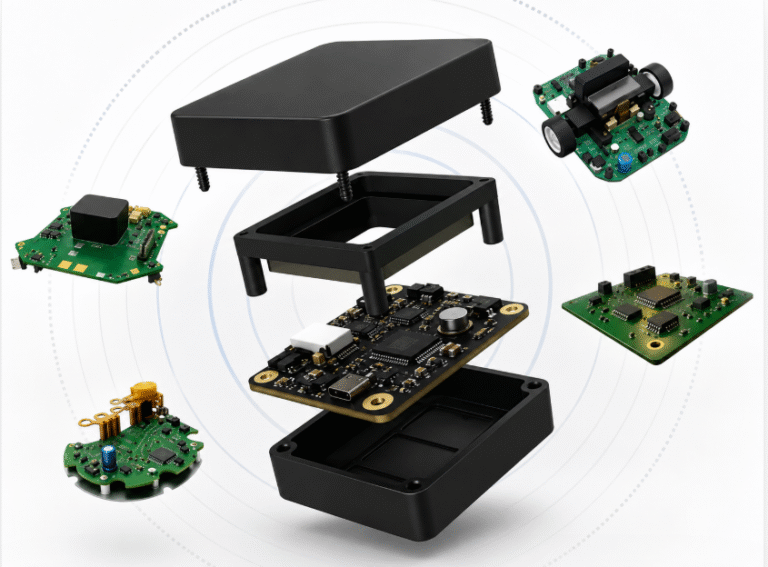
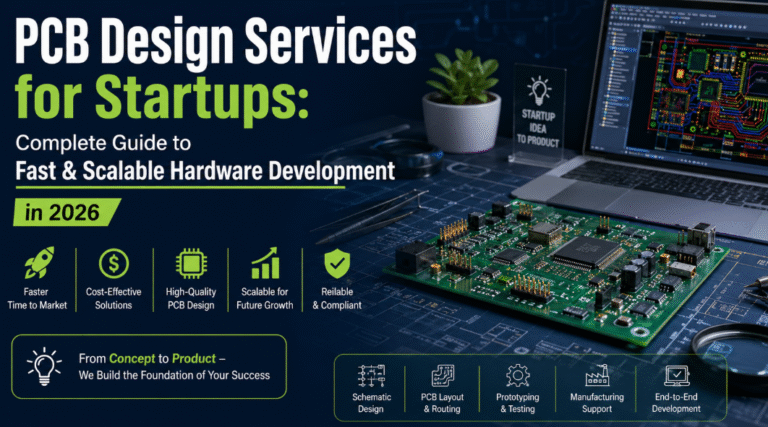
Once the hardware is selected, engineers design the Printed Circuit Board (PCB).
This is where ideas become systems. A PCB connects all components. Ensures signals flow correctly between them.
Key challenges in PCB design:
- Signal integrity
- interference
- Thermal management
- Space optimization
A well-designed PCB ensures smooth operation,n while a poorly designed one can lead to:
- Data errors
- Overheating
- System instability
PCB design is both technical and artistic. It requires precision and experience.
Firmware Development: The Intelligence Layer
Firmware is what brings hardware to life.
It’s the software programmed directly into the device that controls:
- Input/output operations
- Device logic
- Synchronization
- Communication protocols
Unlike software, firmware must work within strict limits:
- Limited memory
- Limited processing power
- Real-time requirements
This means:
- Code must be optimized
- Every instruction matters
- Efficiency is critical
Good firmware makes a device responsive and reliable. Poor firmware makes it slow and unstable.
Connectivity: Expanding Capabilities
Connectivity turns a device into a smart system.
It allows devices to:
- Communicate with each other
- Send and receive data
- Connect to cloud platforms
Common connectivity technologies:
- Wi-Fi for data transfer
- Bluetooth for short-range communication
- Cellular networks for remote access
- Low-power networks for IoT devices
Connectivity introduces new possibilities:
- Remote monitoring
- Real-time updates
- Automation and control
This is a driver of growth in Embedded Systems Development UK.
Sensors and Actuators: Bridging Digital and Physical Worlds
Smart devices interact with the environment using sensors and actuators.
Sensors collect data:
- Temperature
- Motion
- Light
Actuators perform actions:
- Motors
- Relays
- Displays
- Valves
The process looks simple. Involves challenges:
- Accuracy
- Noise reduction
- Real-time processing
For example, a small delay in a safety system can lead to consequences.
This layer is what makes devices truly “smart” in real-world applications.
Power Management: Designing for Efficiency
Power is one of the constraints in embedded systems.
For:
- Wearables
- Remote IoT devices
- Battery-powered systems
Engineers must design systems that consume minimal energy without sacrificing performance.
Techniques include:
- Sleep and low-power modes
- Efficient voltage regulation
- Smart resource allocation
Power efficiency directly affects:
- Battery life
- Maintenance cost
- User experience
A designed system can run for months or even years on a single battery.
Validation: Ensuring Reliability
No system is complete without testing.
Testing helps identify:
- Hardware faults
- Software bugs
- Performance issues
Types of testing:
- Functional testing
- Stress testing
- testing
- Integration testing
Real-world conditions are unpredictable, so engineers simulate different scenarios to ensure reliability.
Security: A Critical Requirement
As devices become connected, security risks increase.
Threats include:
- Data breaches
- Unauthorized access
- Device manipulation
Security measures:
- Encryption
- Secure boot processes
- Authentication systems
- Regular updates
Security must be built into the system from the start. Not added later.
A secure system protects both users and data.
Manufacturing: From Prototype to Product
Building a prototype is the first step.
Scaling involves:
- Mass production
- Cost optimization
- Quality assurance
Challenges include:
- Maintaining consistency
- Reducing defects
- Meeting industry standards
This stage determines whether a product succeeds in the market.
Engineering decisions made here directly impact business outcomes.
Real-World Applications of Smart Devices
Smart embedded systems are used in every industry:
Healthcare
Wearable devices monitor health. Provide real-time data.
Automotive
Modern vehicles include driver assistance systems.
Smart Homes
Devices automate lighting, security, and climate control.
Industrial Automation
Machines operate with precision and efficiency.
These applications show how embedded systems are shaping life.
Future Trends in Smart Device Engineering
The field is evolving rapidly.
1. Artificial Intelligence Integration
Devices are becoming capable of learning and adapting.
2. Edge Computing
Processing data locally for response times.
3. Miniaturization
Smaller devices with power.
4. Energy Efficiency
Focus on low-power designs.
5. Advanced Connectivity
Faster and more reliable communication technologies.
These trends will continue to push the boundaries of what devices can do.
Challenges Engineers Face
Despite advancements, engineers still face challenges:
- resources
- Complex system integration
- Power constraints
- Security risks
- Cost pressures
Solving these challenges requires:
- Experience
- Creativity
- Continuous learning
Why This Journey Matters
The transformation from silicon to solutions is more than engineering. It’s innovation in action.
It enables:
- Better quality of life
- Increased efficiency
- technological possibilities
Every smart device represents a combination of thoughtful design and technical expertise.
Engineering Beyond Technology
At its core, engineering is about solving problems.
It’s about creating systems that:
- Work
- Adapt to needs
- Improve life
From a tiny silicon chip to a fully connected smart system, every step reflects careful planning and execution.
Final Perspective
The journey from silicon to solutions is still going on. We are talking about the journey from silicon to solutions. The journey from silicon to solutions is not over yet. As technology gets better, devices will get smarter. They will work faster. There are companies like Avantari Technologies that are helping to make this happen. These companies are making embedded solutions.
The work that Embedded Systems Development UK is doing will be very important for the future of devices.